
Wright Field, 1942

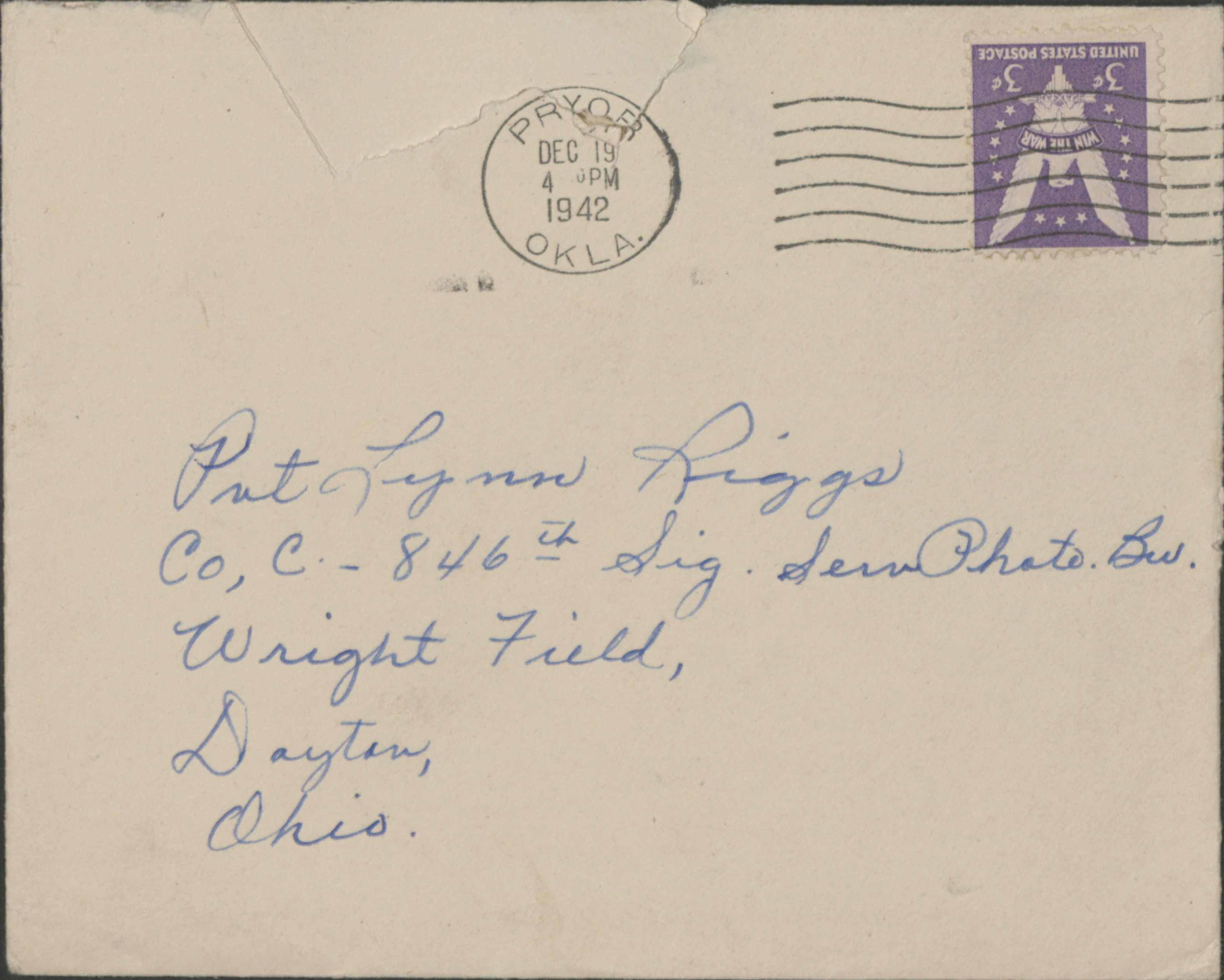
The envelope arrived at Wright Field in December 1942, postmarked Pryor, Oklahoma, December 19, 4 PM. It was addressed in careful handwriting:
Pvt Lynn Riggs
Co C - 846th Sig. Serv Photo Bn
Wright Field, Dayton, Ohio
Inside was a greeting card with a cartoon soldier saluting beneath an American flag. “HI’YA Soldier!” it read. “Here are 48 Good reasons…” The interior spread showed a map of the United States with all forty-eight states outlined in red. Across the bottom, in the same careful hand:
”…WHY WE’RE Proud of YOU! Congratulations!”
And then, in blue ink: “Mr and Mrs Willard Jennings, used to be Dolores…”
On the facing page, Dolores had written:
“Uncle Lynn!
This is it - he’s a year old in this picture - sure is mean they say! He takes after me when I was a kid, remember? Hoping you have a very Merry Christmas & a nice New Year!
Love to You-
Dolores”
A photograph was enclosed: Larry Dean Jennings on his first birthday, standing in a playpen on a dirt yard in Picher, Oklahoma. Behind him, a dark sedan, and behind that, a small house. The baby looked directly off to the side of the camera, serious, unsmiling.
Lynn kept the card. It survived the war, survived his moves from Dayton back to New York, from New York to Shelter Island. He died in 1954, it was among his papers. Eventually it made its way to the Beinecke Library at Yale, where it sits today in Box 3, Folder 60 of the Lynn Riggs Papers, catalogued alongside his manuscripts and correspondence with Bette Davis and Joan Crawford.
I cannot prove that Lynn ever met Willard Jennings, Dolores’s husband, my grandfather. I cannot prove they ever shared a bourbon in a bar across from the St. James Theater in March 1943, though the scene pleases me to imagine:
EXT. WRIGHT FIELD, OHIO
We see footage of Wright Field from WWII.
NARRATOR: Riggs served with the signal corp in Ohio, writing scripts for the army to make various types of training films.
EXT. TRAINING FILM FOOTAGE
We see an example of the type of film Riggs would have created.
NARRATOR: Riggs is given leave to New York City to see the premiere of “Oklahoma” on Broadway, in March of 1943.
CUT TO:
EXT. ST. JAMES THEATER, 44TH STREET
Titles: 1943
We see a group of soldiers walking through Times Sq. We focus in on two soldiers talking to each other. One soldier suddenly notices a marquee for OKLAHOMA. The other soldier hits his shoulder and begins to laugh.
CUT TO:
EXT. RESTAURANT NYC
We see the St. James Theater across the street from inside a bar where we see Lynn sitting, nursing a bourbon. He’s in uniform, surrounded by other soldiers, all much younger. We see a young soldier enter the bar at the front of the establishment, WILLARD JENNINGS, Willie’s son-in-law. Willard is on his way to the European Theater. As was custom, soldiers were given a choice of ticket to see a musical or film. Willard finds Lynn at the crowded bar, and they shake hands and make pleasantries.
LYNN RIGGS: What would you like to drink?
WILLARD: I’ll have a beer - it’s too early for me to have whiskey.
Lynn motions to the bartender, who sees Lynn and comes to his end of the bar.
LYNN RIGGS: My fellow soldier will have a beer.
BARTENDER: You want light or dark?
WILLARD: I’ll have a dark beer.
The bartender grabbed a glass and tapped a dark beer for Willard, placing it in front of him. Lynn, nodded to the barkeep that he’d be paying the tab.
LYNN RIGGS: When do you ship off?
WILLARD: Tomorrow morning, 0600. When do you go back to Ohio?
LYNN RIGGS: I head back day after tomorrow, I have some people I want to see - I can hop any number of trains, you know how I am.
WILLARD: Yes I do. You always have a way of gettin’ around.
LYNN RIGGS: Yes, well, if this musical does well, I might not have to move around so much. How’s your mother-in-law?
WILLARD: Bill? She’s fine - you know, a little wild. She’s playing cards at night in Tulsa, on Gillette. Dolores and Larry Dean are in Pryor, as was my job at the Oklahoma Ordnance Works.
LYNN RIGGS: When you get back from the front, no more powder or mining...we’ll get you a job at the bank with my dad...
WILLARD: I thought your dad didn’t pay attention to you?
LYNN RIGGS: He doesn’t, but I can speak to Willie, and she has a way with words. Did you come with any friends?
WILLARD: I told a couple I’m going with that I’d see them after the show, I wanted to experience this with you.
LYNN RIGGS: Ok, well - let’s go see who we can see. You’ll have to help me carry these bags, I bought gifts for the cast.
WILLARD: That’s awfully nice of you...
LYNN RIGGS: Oklahoma! might keep me in bourbon for a while...I’m not worried about money at the moment.
Six months before that opening, Lynn reported to Wright Field, Ohio, where he would spend the next two years scripting documentary films for the Office of War Information.
Lynn arrived at the Training Film Production Laboratory in August 1942, two weeks before Charles William Watson died.
The facility sat on the sprawling Army Air Forces base in Dayton, a cluster of buildings where civilians and enlisted men worked side-by-side producing the training materials that would prepare American forces for combat. Lynn had been assigned to script work: converting technical procedures and strategic concepts into narratives that young pilots and bombardiers could absorb quickly. After years of scrambling from paycheck to paycheck in Hollywood and New York and Santa Fe, the military’s institutional predictability felt almost luxurious.
“How long have you been in the army?” the interviewer asked. Her name was Polly, and she was recording interviews with new recruits for a features piece.
“Exactly two weeks today,” Lynn said.
“And how does it feel to take orders instead of giving them?”
Lynn laughed. “Look, all my life, certainly all my professional life, I’ve had to give orders to myself. It’s a hard life. I’m leading a new one. Somebody else has to think up the orders and it’s a great relief to me.”
“Well, Private Riggs, how do you like having your fancy ruled by fact?”
“Actually, I should say, it always has been. It’s a mistaken notion that honest, creative writers deal in fancy. They deal with the world the way it is. In civilian life, I looked at the world, commented on it, in plays. Now I’m in the army. This is a new kind of reality. Now I listen to orders and don’t comment on it. This new life is in front of me, it has life and color and excitement in it and I LIKE IT.”
He meant it. The routine felt clean, purposeful. No more wondering where the next commission would come from, no more oscillating between coasts. Just wake up, report, do the work, sleep. There was comfort in that.
Charles William Watson felt differently.
Watson was thirty-one years old, a civilian photographer who’d been hired by the Training Film Production Laboratory on March 4, 1942. He lived at 403 West First Street in Dayton with his wife. According to the personnel file that would later be scrutinized by Army investigators, he had been born in Owensboro, Kentucky, stood five-foot-eleven-and-a-half, weighed 160 pounds, had a dark complexion, brown eyes, and brown hair. He was fingerprinted and classified on March 4, 1941, assigned Clock Number 101-18. His grammar school education had been completed through the 8th grade. His high school education: “Completed 12th Grade (Verified).” He’d attended the Air Corps Technical School of Aerial Photography. Under “Affiliations,” the form said: “None.”
The investigation that followed his death would paint a more complicated picture.
Watson had appeared to be “very quiet, backward sort of person, intensely interested in his work, and a very good employee,” according to interviews with his supervisors. But something had shifted in the weeks before his death. He’d become “jolly, friendly, and at times carefree,” even drunk occasionally, “although he seldom became intoxicated to any extent.” He’d told people he was thinking about going to Buffalo, New York, “to take a test in connection with some OAA position as a pilot,” or maybe attending “officers training school,” or studying “radio, and numerous other possibilities.” It appeared, the investigators noted, “that he was unsettled during the July and August, 1942, period and could not decide upon what future course to pursue.”
His last official day of work at the Training Film Production Laboratory was August 17, 1942. He’d been on annual leave starting August 18.
But Watson kept showing up.
On September 5, 1942, he was issued a new Temporary Pass by Assistant Provost Marshal, Captain W. P. Ringo. Watson was wearing Army clothes. He said his Army Serial Number was 15,117,128.
On September 7, 1942, Watson came to the Investigational Unit at Wright Field and reported that he had left some whiskey with the Guard at Gate 6. When asked if he was on leave from the Army, he produced a regular leave form showing that he was on leave and that his passage on a plane had been granted.
The next day, Watson climbed aboard a B-25 medium bomber.
At approximately 12:03 PM on September 8, 1942, the aircraft “careened crazily” over downtown Newark, Ohio, dove suddenly, and plunged into a residential neighborhood at the corner of Hudson Avenue and Wyoming Street.
The Ohio State Highway Patrol report, filed by Captain Ralph R. MacCracken of the Lancaster Auxiliary Post, describes what happened next with the flat precision of institutional documentation:
“Time of Crash: about 12:03 PM September 8th, 1942. Weather conditions: raining very hard, local storm, not much wind, which was from West-Southwest. Little if any lightning. Witness: almost nil. Cloud very low, estimated at about 1,200 to 1,500 feet, dark gray to bluish black. Temperature: about 75 (F.)”
The B-25 hit a frame house first. A home owned, by coincidence, by a Mrs. Watson, no relation. The plane careened through the second-floor window, demolished the east wall, crashed through to the basement. One wing clipped a neighboring house, a two-story affair, and brought it down. The fuselage itself continued across Hudson Avenue, struck other buildings. A woman walking on Wyoming Street was pinned against the south wall of a building by falling debris. The body of one crew member, ‘evidently an Officer-occupant,’ was found about two blocks east of the scene, on the concrete ramp of the B. & O. Freight Depot, belly mangled, parachute evidently opened, but due to rain or low altitude, in jumping, it did not have time to open.”
Streets, yards, and nearby homes were littered with wreckage. All three homes caught fire from the crash explosion and escaping gasoline.
The Fire Department, according to Captain MacCracken, “was evidently not prepared to handle a major catastrophe of this magnitude, with the proper chemicals, as only water was being used. Lack of adequate equipment, such as hose, ladders, was especially noticeable.”
By the time the fires were contained, fourteen people were dead: five military personnel and nine civilians. Among the dead: Mrs. Paul Winsch, Mrs. Walter Walsh, Mrs. Dolly Campbell, Mrs. Weston (a resident of the apartment building where Mrs. Campbell’s body was found), and a woman struck down on Wyoming Street, killed instantly. A ten-year-old schoolboy was injured by flying debris. Four Army Air Corps officers’ duffle bags were recovered from the wreckage.
Charles William Watson’s body was found in the wreckage of the apartment building. He had been aboard the plane without authorization.
The investigation began immediately.
On September 13, 1942, five days after the crash, T. E. Sibert, 1st Lt., Sig.Corps, Unit Executive Officer, requested “a thorough investigation be made of the honesty and integrity of the employees listed below, of the Training Film Production Laboratory, Signal Corps, Wright Field, Dayton, Ohio, whose duties may involve matters of a confidential or secret nature.”
Two names appeared on the list, designated by priority:
(a) Rush A-1 Priority
(b) Routine Priority: Charles Watson
The confidential investigation that followed interviewed dozens of Watson’s colleagues, supervisors, neighbors, and acquaintances. What emerged was a portrait of a man unraveling.
Watson had told people he’d served two years in the Canadian Air Force. This was a lie. He claimed the purpose of his trip to Canada in July 1942 was “to enlist in the Canadian Air Force as a pilot.” No record of such enlistment existed. He’d made claims “to various persons that he at one time served two years in the Canadian Air Force,” the investigators noted. This also “could not be verified.”
On August 15, 1942, Watson had submitted a statement to the Wright Field Identification Sub-Unit saying that he had lost his Wright Field Identification Pass and Badge. A new Temporary Pass was issued. When he left Wright Field on August 18, officially beginning his annual leave, he turned in his Permanent Pass and Badge but kept the Temporary Pass. On September 5, wearing Army clothes and claiming an Army Serial Number, he obtained yet another Temporary Pass from Captain Ringo.
He used these passes to access Wright Field repeatedly during what was supposed to be his vacation.
During the early part of August 1942, Watson had approached the Supply Officer at the Training Film Production Laboratory and claimed he wanted to complete some test flights “for something in connection with the OAA,” and requested the loan of a Government parachute. His request was denied.
On Saturday, September 5, 1942, Watson inquired at the Wright Field Operations Office about passage to New York by Army aircraft. He was advised that space would be available on a plane which was expected to leave Monday morning, September 7, 1942. “He was advised that if he were on hand with proper indication that he was on leave from the Army, he would be permitted to travel on the plane.”
On various occasions, September 5, 7, and 8, 1942, when Watson called at the Training Film Production Laboratory, he was observed carrying a pair of aircraft type earphones and was reported to have remarked that he was to be the radio operator on the trip East on September 8, 1942. Investigation failed to disclose where he obtained the earphones, or for what real purpose he had obtained them.
The investigation concluded with a character assessment: “The investigation failed to disclose any associates or connections of a questionable character, although subject is reported to have occasionally patronized second rate drinking places. There is considerable indication, especially during the last two months, that subject was given to spells of melancholy; that he told numerous fanciful tales concerning himself; that he became dissatisfied with his work; that he was unable to decide upon a future course. At times, during the past two months, he was definitely ‘peculiar’ and ‘odd,’ but nothing was developed to indicate actual insanity.”
The investigators noted one more detail: “Subject registered at the Gibson Hotel, Cincinnati, Ohio, at 2103, September 4, 1942, as Private Charles W. Watson, Wright Field, Dayton, Ohio, and departed on the 6th, or 7th, without settling his account at the hotel.”
The report was signed by committee members and approved. The document was stamped CONFIDENTIAL. Charles William Watson was buried. The wreckage was cleared. The investigation was filed.
Lynn Riggs continued scripting training films at Wright Field.
Lynn witnessed the institutional apparatus that investigated Watson’s character, documented the crash, filed the confidential reports, assigned blame to “structural failure” and bad weather, noted that the pilot’s statement couldn’t fully explain the causes, and then moved on with a final recommendation of “No recommendations.”
The institution absorbed Watson’s death, processed it, archived it, and continued operations.
Lynn survived the war. He returned to playwriting, though nothing he wrote afterward matched the success of Green Grow the Lilacs or its musical adaptation. He bought a farmhouse on Shelter Island. He spent time in New York, in Chapel Hill, moving as he’d always moved. His health deteriorated in his early fifties.


