Media

Cable television created something unprecedented: a system that required capital, craft, and collaboration. It paid people to make things. The math was simple and powerful: cable subscribers paid monthly fees that funded content production, advertisers paid to reach those subscribers, professional crews produced that content, unions negotiated wages for those crews, and artists could build careers.
This wasn’t charity. It was capitalism that happened to create jobs for artists and for the massive support infrastructure that made those artists’ work possible. Cable companies needed content. Content required production. Production required skilled labor. But all of it required something even more fundamental: the physical construction, maintenance, and operation of a vast technological ecosystem.
Radio tower construction crews. Coaxial cable installers. Transmitter technicians. Headend engineers. Satellite uplink operators. The local TV repair shop. The antenna installer climbing residential rooftops. The specialized ironworkers who built transmission towers. The electrical contractors who wired studios with soundproofing and acoustic treatments. The fiber optic crews digging trenches and stringing cable on poles across entire states.
These weren’t artists. But they were part of the ecosystem that sustained artists. The invisible hand of the market accidentally built an infrastructure that paid cinematographers, directors, editors, writers, actors, grips, gaffers, sound engineers, producers and the thousands of technicians, construction workers, manufacturers, and support personnel whose work made the entire system function.
I grew up with film as the cultural centerpoint of art. Not film as hobby. Not film as self-expression. Film as profession, supported by an economic and physical infrastructure.
That world has largely disappeared. The economic model has fundamentally transformed. The employment landscape is unrecognizable.
What replaced it wasn’t a better economic model for artists or infrastructure workers. It was a dual destruction: progressive policies that inadvertently contributed to dismantling organized labor’s structural foundation while platform capitalism figured out how to monetize attention without compensating the people who create it or building the kind of employment-generating physical infrastructure that previous technological eras required. The Obama administration called their policies progress. Social media platforms called theirs democratization. Both contributed to what I can only describe as cannibalization.
This is the story of how the economic model that sustained professional artists and the physical infrastructure that employed hundreds of thousands was systematically dismantled from above by well-intentioned policy and from below by extractive technology, and how my generation, raised in the world cable built, watched the entire structure collapse in real time.
The “Golden Age” of radio and the rise of television weren’t just cultural phenomena, they were industrial revolutions that created entire employment sectors.
The console radio in your living room required specialized factories producing vacuum tubes, capacitors, resistors, and speakers, a significant wartime and post-war industrial sector. Cabinet makers created the furniture-grade wooden consoles. Mining operations extracted copper for wiring and coils, aluminum, steel, and zinc. Early plastics factories produced Bakelite for radio knobs and switches.
But the real employment boom was in construction. Radio tower construction crews, specialized ironworkers and riggers, built massive AM/FM transmission towers across the country. Transmitter sites required standard construction for secure buildings housing powerful equipment, often in remote locations. Electrical contractors installed high-voltage systems. Soundproofing crews built studios with complex acoustic treatments.
And powering it all: local power grid expansion to handle transmitters that consumed substantial electricity, connected to the New Deal-era rural electrification projects that brought power to previously unserved areas.
The 1950s shift to television demanded an entirely new industrial base. Cathode Ray Tube (CRT) manufacturing, a complex, glass-intensive process requiring specialized factories. Glass manufacturing facilities dedicated to making the thick, leaded glass for screens. Coaxial cable production lines, and critically: the local TV repair shop, a thriving small-business sector that employed neighborhood technicians in communities across the country.
Construction boomed: local antenna installers mounted multi-element antennas on residential rooftops. Tower and transmitter construction duplicated the radio boom at larger scale. AT&T built a massive microwave relay network: a series of towers across the country linking cities for live national broadcasts. Studios required warehouse-sized facilities with high ceilings for complex lighting grids.
The power demand was substantial. Early TV sets used many vacuum tubes and were extremely inefficient, significantly increasing household power consumption and straining local grids. TV manufacturing, glass making and tube assembly, consumed industrial-scale energy.
All of this physical infrastructure created stable, localized employment..and stable employment created the foundation for union power.
American unions built their modern power on an accident of history. During World War II, federal wage and price controls prevented employers from offering higher salaries. Employer-sponsored health insurance emerged as a workaround. Unions seized this opportunity and made healthcare the cornerstone of their bargaining strategy for seventy years.
By 1983, union workers were 10% more likely to have health insurance coverage than non-union workers. For many workers in broadcasting, construction, manufacturing, and film production, the union card meant the difference between medical bankruptcy and security. The question “Why join a union?” had a simple answer: “Because you need health insurance, and we can get it for you.”
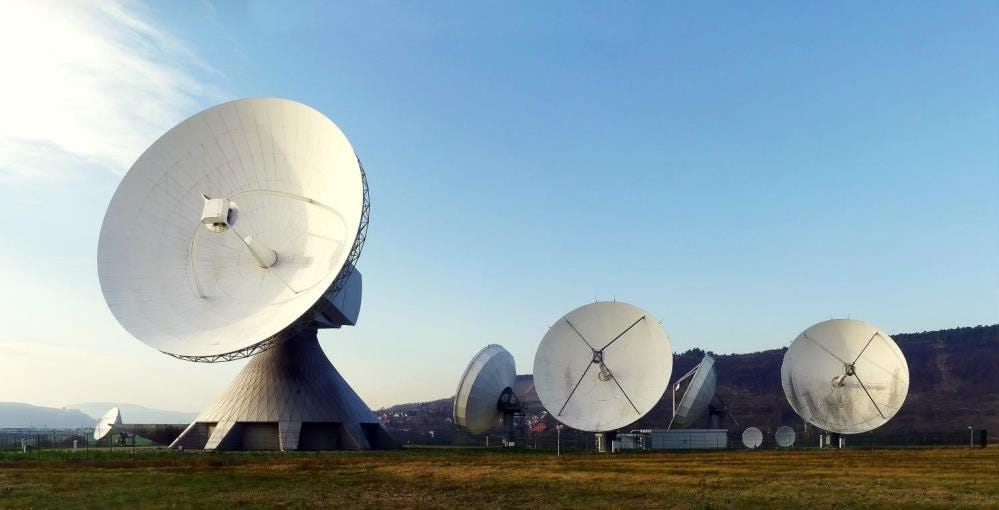
The 1970s brought color television and the very beginning of cable. Color CRT manufacturing was far more complex than black-and-white, requiring rare-earth phosphors and chemically sensitive processes. Satellite technology revolutionized content distribution, but required the development, launching, and operation of communications satellites, plus massive C-Band satellite dishes at cable headends and broadcast stations.
Cable infrastructure demanded substantial construction workforces: utility crews stringing coaxial cable on telephone poles in suburban neighborhoods. Headend construction: specialized central hubs receiving satellite signals. Studio upgrades for Electronic News Gathering (ENG) facilities handling the shift from film to video tape.
The power requirements continued escalating: grid modernization to support universal color TV adoption, satellite uplink transmitter facilities, and the beginning of “phantom” power drain from the proliferation of devices (TV, VCR, cable box, stereo).
The cable explosion of the 1990s represented the peak of physical media infrastructure. The video rental industry: Blockbuster and thousands of competitors employed tens of thousands in retail, logistics, and distribution. Manufacturing lines produced VHS tapes and DVD players. Most critically: the universal cable rollout, a national construction boom with utility crews digging trenches and running cable to reach the vast majority of American homes.
Hybrid Fiber-Coax (HFC) networks integrated high-speed fiber optic backbones with local coaxial distribution. Early digital cell tower construction utilized existing TV/radio sites. The sheer number of devices in homes multiplied, each requiring power, each requiring manufacturing, each creating employment.
These were jobs. Real jobs. Construction jobs. Manufacturing jobs. Retail jobs. Technical jobs. Union jobs. The infrastructure didn’t just deliver content, it employed substantial portions of many communities.
Because all of this infrastructure required capital and craft, media production was selective. Equipment cost tens of thousands. Skilled crews required training. Post-production needed facilities. Distribution required networks of cables, satellites, and towers built by union labor.
A single 30-second national commercial employed 50-100 people directly: IATSE crews, Directors Guild members, SAG-AFTRA talent, cinematographers, editors, sound designers, composers, colorists. A national campaign running for a year could generate substantial production fees and residuals. This work allowed people to buy houses, send kids to college, retire with pensions.
The barrier to entry created scarcity, and scarcity created value. Film mattered. A music video premier on MTV was a cultural event. A Super Bowl commercial was analyzed for days. A new HBO series was appointment viewing.
These two pillars, union healthcare and cable infrastructure, were separate but reinforcing. Unions thrived because production work was steady and localized. Cable thrived because union labor provided quality and reliability. Together, they created what seemed like a permanent feature of American economic life: the professional artist class and the industrial working class that made their work possible.
When the Obama administration passed the Affordable Care Act in March 2010, it aimed to expand healthcare access to millions of uninsured Americans. The policy succeeded - coverage rates increased dramatically. But this success came with an unintended consequence: it weakened one of organized labor’s most powerful recruitment tools.
For the first time, workers could access affordable health insurance without collective bargaining. Exchange subsidies created an alternative pathway: one that required no dues, no strikes, no solidarity. The practical effect at the bargaining table was measurable. Unions faced a new challenge: should they negotiate for higher wages instead of health benefits? But…increasing wages could make workers ineligible for exchange subsidies. A bargaining dynamic that had governed labor negotiations for decades was fundamentally altered.
Multi-employer Taft-Hartley plans, a backbone of union coverage in construction, food processing, seafaring, and film production, faced a particularly acute challenge. These jointly managed union-employer health plans weren’t eligible for ACA subsidies. Union leaders watched as employers gained new financial incentives to shift union workers onto public exchanges rather than continue contributing to union-managed plans.
Terry O’Sullivan, president of the Laborers International Union, stated it bluntly at the 2013 AFL-CIO convention: “If the ACA is not fixed, if it destroys the health and welfare funds we fought for, it needs to be repealed! The proud men and women we represent cannot be collateral damage!”
These weren’t Republican talking points - this was organized labor recognizing a serious threat from its own political allies.
The ACA didn’t destroy unions single-handedly, but it did remove a critical advantage they offered. Union workers still maintained better quality of care and lower out-of-pocket costs, but the gap between union coverage and non-union coverage had narrowed from “coverage vs. no coverage” to “better coverage vs. adequate coverage.” That shift changed the organizing calculus significantly.
Parallel to the ACA rollout, the Obama administration pursued aggressive enforcement against independent contractor misclassification.
The policies weren’t coordinated, but their timing created a problematic interaction. The administration was expanding who counted as an “employee” at the same time it was changing what “employee” status meant in terms of healthcare security.
In isolation, either policy made sense. Together, particularly in industries facing global competition, they created unintended pressures.
The fundamental question that appears to have been overlooked: “If we give workers healthcare access without unions, how does that affect the union value proposition?”
For high-skill workers: electricians, pipe-fitters, machinists, broadcast technicians, unions still offered apprenticeship programs, skill certification, and wage premiums. But for many workers in service industries, retail, hospitality, light manufacturing, and film production, healthcare had been the primary reason to organize.
The ACA answered that need through government action rather than collective action, and in doing so, it removed what had been unions’ most powerful recruitment tool, not just for artists, but for much of the infrastructure workforce that made media possible.
This wasn’t the only factor in union decline. Globalization, automation, right-to-work legislation, and changing labor law enforcement all played significant roles. But the ACA’s impact on union organizing leverage deserves recognition as a contributing factor that progressive policymakers hadn’t anticipated.
The 2000s represented a fundamental shift: the moment broadcast media went digital and merged with the internet. The physical infrastructure that had employed substantial workforces began its transformation into something fundamentally different.
Instead of tower construction crews and cable installers, the new infrastructure was data centers: massive facilities housing thousands of servers. But here’s the critical difference: a data center employs far fewer people relative to its output than the equivalent broadcast infrastructure it replaced.
A radio tower required construction crews, maintenance technicians, transmitter engineers, and local repair shops. A data center requires a fraction of that labor per viewer served - mostly during construction, with significantly reduced ongoing employment. The servers are largely self-monitoring. The cooling systems are increasingly automated. The security is primarily electronic.
Cloud computing services (like Amazon Web Services, launched in 2006) provided scalable infrastructure for new digital platforms. But “scalable” often meant labor-efficient, reducing the human involvement required per unit of output.
Semiconductor manufacturing exploded with demand for processors and memory. But those factories were increasingly automated and located overseas. The E-waste recycling industry emerged to handle discarded CRTs and analog equipment, but generally paid substantially less than what manufacturing jobs once did.
Fiber-to-the-home rollouts (like Verizon FiOS) still required construction, but it was largely a one-time build rather than ongoing employment. Data center construction became hyper-specialized - a smaller sector focused on electrical, HVAC, and fire suppression systems, employing fewer workers than the broad-based construction employment of previous eras.
Data centers consume massive power but create substantially less employment per watt consumed than broadcast infrastructure did. They can rival small cities in energy use, for servers and cooling, but employ hundreds where broadcast infrastructure employed thousands.
Commercial video production represents a clear example of how progressive labor policy contributed to accelerating offshoring rather than protecting workers.
The industry already operated under complex union systems: IATSE craft unions, Directors Guild, and SAG-AFTRA. SAG residuals created significant cost pressures: advertisers paid talent repeatedly, an initial fee, then residuals every 13 weeks. A two-year campaign could accumulate substantial residual costs.
Starting in the 1990s, productions discovered foreign buyouts: shoot in Canada, South America, Europe, pay talent once. A U.S. union campaign with substantial residuals became a significantly cheaper Canadian buyout. Production increasingly moved offshore. Toronto became “Hollywood North.” Prague, Buenos Aires and Cape Town all became hubs for American advertising specifically to avoid union obligations.
Then came Obama’s contractor classification crackdown. The industry was already facing intense offshore competition. Tightening contractor rules added domestic compliance costs at exactly the wrong moment - it didn’t protect American workers so much as it made U.S. production comparatively less competitive.
9/11 (2001) normalized remote collaboration. The friction that made foreign production inconvenient was reduced.
The 2008 Financial Crisis devastated advertising budgets. Survivors learned to operate leaner. The full-time employee model gave way increasingly to contractors. More fundamentally, 2008 created a shift in expectations. The generation entering the workforce after 2008 had different assumptions about job security, pensions, and union protection.
COVID-19 accelerated existing trends. Productions shut down. When they resumed, work was more scattered, more remote, more frequently non-union. The pandemic demonstrated that physical presence was often optional, and if physical presence wasn’t necessary, the argument for maintaining higher U.S. wages was further weakened.
Similar dynamics affected tech employment. Companies relied heavily on contractor relationships for project-based work. Obama’s DOL reclassification push affected tech at a challenging moment. Global competition for software development was already intense.
When companies faced the choice between reclassifying contractors as employees or expanding offshore operations to countries without such requirements, many chose the latter. Jobs increasingly moved overseas.
The policy combination didn’t protect as many American workers as intended. Instead, it contributed to making them more expensive relative to global alternatives at the same time that one of their key advantages was diminishing.
The 2020s represent near-total media convergence and a dramatic transformation of the employment model. The physical infrastructure that once employed substantial workforces has been largely replaced by code that requires far fewer workers.
From the advertiser’s perspective, TikTok offers superior ROI. From the employment perspective, the difference is substantial.
Platforms presented this transformation as democratization. Anyone can create content! Anyone can build an audience! You don’t need gatekeepers!
The old system had gatekeepers who compensated selected artists AND built infrastructure that employed substantial workforces. The new system has algorithmic curation that provides minimal compensation AND requires proportionally less labor-intensive infrastructure.
The barrier to entry dropped dramatically. The ability to make a sustainable living from content creation became far more difficult for most creators. And the infrastructure jobs were substantially reduced.
Social media platforms replaced editorial judgment with algorithmic curation. The algorithm optimizes for engagement rather than craft, skill, experience, or traditional artistic merit.
Professional artists who spent years developing craft found themselves competing with content creators who understood platform algorithms. Success metrics shifted fundamentally.
When anyone can create content and algorithms determine visibility, traditional craft becomes less relevant to success. A carefully composed 35mm film image competes with phone footage on engagement metrics. Traditional measures of quality became secondary to engagement optimization.
The skills my generation developed became less economically relevant not because they lost inherent value, but because the economic system shifted to reward different attributes and the infrastructure that once required those skills had been largely replaced by automated systems.
The cable infrastructure that had sustained professional artistic careers AND employed substantial support workforces for half a century faced simultaneous pressures from well-intentioned progressive policy that hadn’t fully considered institutional consequences. Platform capitalism monetized attention without proportionally compensating creators or building employment-generating infrastructure.
The old model supported mid-career workers across multiple sectors:
Artists: Working cinematographer earning $80,000-$200,000+ annually shooting commercials. Working editor cutting promos. Working composer scoring industrial films.
Infrastructure: Cable installer with union benefits. Broadcast technician maintaining transmitters. Equipment repair shop owner. Construction crew building towers and headends.
Many of these careers contracted significantly. Corporate video increasingly went in-house, local cable shops closed as equipment became disposable. Commercials shifted toward social media, data centers replaced broadcast infrastructure. Even high-end work dispersed: streaming could produce anywhere with reduced local infrastructure requirements.
What remained was increasingly bifurcated: a small number of highly successful creators (directors, showrunners) and data center executives, plus a large number of aspiring creators making content with minimal compensation and former infrastructure workers facing limited opportunities.
The professional artist class AND much of the infrastructure working class faced substantial contraction.
Unions had thrived when collective action was both necessary and feasible. Crews worked together on sets. Cable installers worked on crews together. They shared workplaces and grievances.
Social media creators typically work independently. Many former infrastructure workers are unemployed or in different industries. Shared workplace, common employer, the traditional bases for collective action, are often absent.
In the Cable model, artists earned ongoing payments, infrastructure workers had stable employment with benefits. In the Social media model: artists typically receive no residuals and the infrastructure workers face reduced employment opportunities.
My father’s generation built physical infrastructure requiring ongoing maintenance and creating sustained employment. Social media runs largely on automated systems. Creators don’t own it, infrastructure workers don’t maintain it at previous scales.
When infrastructure was physical and expensive, there was investment in stability and employment. When infrastructure is code, it operates with proportionally less human involvement.
Cable created shared cultural moments maintained by shared infrastructure. Major series finales drew enormous audiences. Everyone relied on the same cable system installed by local crews, maintained by local technicians.
Social media fragments culture into numerous micro-communities served by largely invisible, automated infrastructure. Monoculture has largely dissolved. Shared moments are rarer. Infrastructure is invisible and requires proportionally less local employment.
This fragmentation affected the economic model substantially. Advertisers had paid premium rates to reach mass audiences on cable - rates that funded both content creation AND infrastructure employment. In a fragmented landscape, advertising shifted to programmatic buying that reduced premiums and largely eliminated the traditional infrastructure employment model.
Film represented singular vision created by artists and supported by substantial physical infrastructure that employed thousands.
Social media increasingly emphasizes distributed content served by automated infrastructure that employs proportionally fewer workers. The platform becomes the primary organizer. Content is more interchangeable. Infrastructure is largely invisible and automated.
Film required attention, engagement, interpretation, and a vast support system of physical infrastructure. Social media optimizes for engagement and operates on servers that are largely self-managing.
The cable era offered mentorship across sectors. Editors taught assistant editors. DPs taught camera assistants. Senior cable installers trained apprentices. Broadcast engineers trained junior technicians.
In the social media era: many learn from online tutorials rather than workplace mentorship. The craft becomes less deep in many cases. The infrastructure skills face reduced demand - fewer jobs to train for.
There’s less institutional transmission of cinematography when it correlates less strongly with algorithmic success. There’s reduced infrastructure apprenticeship when there are fewer infrastructure positions available. Broadcast engineering skills face reduced demand when broadcast facilities have been substantially replaced by automated data centers.
This is the story of multiple, interacting transformations: from above: A Democratic administration, committed to progressive goals, pursued policies with unintended consequences for one of progressivism’s institutional pillars. By providing healthcare access through government programs, they weakened (though didn’t eliminate) what had been unions’ primary recruitment tool - affecting both artists and infrastructure workers. By expanding the “employee” definition while changing what that status meant, they created workers who needed unions less. By tightening contractor classifications without fully considering global competitive dynamics, they contributed to accelerating offshoring.
I watched this unfold in real time. I entered advertising production in the late 1990s when the cable model still largely functioned, unions still controlled healthcare access, and physical infrastructure still employed tens of thousands. I watched offshoring accelerate. I watched the ACA pass and union leverage shift. I watched contractor classification battles. I watched streaming disrupt cable. I watched social media capture advertising revenue. I watched data centers replace broadcast facilities. I watched automation reduce infrastructure employment. I watched COVID accelerate existing trends.
This wasn’t simple creative destruction. The creators faced serious challenges. The infrastructure workers faced serious displacement. The creation continues, but it’s increasingly not a sustainable profession for most. The infrastructure continues, but it’s increasingly not a significant employment source. It’s content, generated by many unpaid or underpaid laborers, served by automated systems, optimized by algorithms, monetized by platforms, in an economy where being an “employee” no longer guarantees the healthcare security that once made union membership essential and where “infrastructure” increasingly means “automated systems” rather than “jobs.”
Progressive policy addressed the healthcare crisis for individuals while inadvertently weakening the institutional power that fought for healthcare in the first place. Platform capitalism reduced barriers to content creation while making sustainable livings from that creation far more difficult AND largely eliminating the infrastructure employment that previous technological eras generated. The transformation of infrastructure from physical to digital substantially reduced jobs relative to output.
More people can create content now than ever before, but far fewer can sustain themselves doing it. Workers can access healthcare through multiple pathways now, but unions have been weakened. Infrastructure can deliver content efficiently now, but far fewer people are employed to maintain it per user served.
The cable era has largely ended. The union era has contracted significantly (though not disappeared). The infrastructure employment era has been substantially reduced. What comes next includes platforms and policies and automation, with real benefits but also serious costs that weren’t fully anticipated - changes framed as innovation and reform and efficiency.
The situation is complex: we achieved broader healthcare access, reduced barriers to content creation, and more efficient content delivery while substantially weakening the economic models that once sustained workers, artists, and the infrastructure that made it all possible.
And now, artificial intelligence has emerged to potentially accelerate these trends - but with characteristics that distinguish it from previous technological disruptions.
The same platforms that normalized uncompensated content creation are now training machine learning systems on that content, generally without explicit permission or additional compensation. Vast quantities of images, videos, and text shared online have become training data for systems designed to generate similar content with minimal human involvement.
However, what potentially distinguishes AI from previous technological shifts may be that it’s the first technology that promises to reduce human labor substantially WITHOUT creating proportionally significant new infrastructure employment to replace it.
Radio required tower construction. Television required antenna installation and repair. Cable required massive physical build-out. Even streaming required data center construction and fiber optic installation. Each previous wave eliminated some jobs while creating others in infrastructure.
AI may require proportionally less. Much of the infrastructure already exists. The hyper-scale data centers, the fiber networks, the cloud computing platforms built for streaming. AI doesn’t necessarily need new towers, new cables, new construction crews at previous scales, it primarily needs more computational capacity within existing frameworks.
Training large AI models requires substantial power consumption, in some cases rivaling small cities. This theoretically should create employment: building renewable energy sources, constructing cooling systems, expanding grid capacity.
But the facilities being built are often “AI Training” centers - hyper-specialized data centers designed primarily for consuming enormous amounts of steady-state power with proportionally minimal human involvement. They’re being built with dedicated renewable energy sources, advanced liquid cooling requiring reduced maintenance labor, and edge computing infrastructure designed for largely autonomous operation.
The jobs created tend to be temporary (construction phase) and proportionally limited (operational phase). The jobs potentially affected are more numerous: artists whose work might be generated by AI trained on previously created content.
Generative AI can produce images that previously would have required photographers, lighting crews, and post-production teams. It can generate video that previously would have employed animators, editors, and VFX artists. It can draft text, compose music, design graphics, often rapidly, at very low marginal cost, trained on vast amounts of previously created work.
It will require proportionally less new employment-generating infrastructure than previous disruptions. Minimal new construction. Minimal new equipment to maintain, just more computational capacity in facilities that increasingly operate with limited human involvement.
What happens when systems trained on human creativity potentially reduce demand for human creators?
What happens when the economic pressure to employ humans is reduced?
What happens when technological disruption affects jobs without creating proportionally significant new infrastructure employment to replace them?
What happens to the training pipeline when the economic model that sustained artistic apprenticeship continues to erode?
The answers are emerging. Artists have filed lawsuits that will likely take years to resolve while AI capabilities advance monthly. Platforms have implemented “opt-out” policies for AI training placing the burden on creators to protect work that may already have been incorporated into datasets. Legislation generally lags substantially behind technological development.
The same executives who built platforms that transformed the creator economy and infrastructure employment are now developing AI systems, continuing to frame it as progress, as inevitable, as the future.
Artificial intelligence potentially reduces demand for human creative labor while requiring proportionally minimal new infrastructure employment, operating largely on automated systems that already exist, consuming energy at scale but potentially creating proportionally limited new jobs.
Multiple generations, multiple transformations, each framed as progress, each building on the previous wave’s changes - but each successive wave potentially creating proportionally fewer jobs relative to those affected.
Perhaps this is inevitable technological progression. Perhaps this is simply another chapter in how economic systems learn to generate output with reduced human involvement. From above, through policy that addressed problems without fully considering institutional consequences. From below, through platforms that monetized attention with minimal compensation. From within, through infrastructure that reduced employment. And from the next wave, through systems that learned to create by training on accumulated output, requiring proportionally minimal new employment in the process.
That’s the pattern. And unlike the previous transformations, this one may not even generate the construction employment that previous waves created, just computational capacity in facilities that largely run themselves, processing information at scale, potentially affecting human employment while creating proportionally limited new opportunities to replace what’s lost.
The AI era is arriving differently, with awareness, with debate, with organized resistance, with alternative models being tested, with questions being asked before outcomes are settled.
The wasteland the current generation inherits is real. The losses are substantial. The challenges are serious. But they’re inheriting it with something my generation and my father’s generation didn’t have: a clear view of how we got here, which means a fighting chance to build something different going forward.
That’s not redemption. But it might be hope. And sometimes, understanding the pattern of how things fell apart is exactly what makes it possible to build differently going forward.
The story isn’t over. The pattern is clear. And what happens next depends on whether we use that clarity to ask better questions, demand different answers, and build with intention what previous generations built by accident, an economic ecosystem that sustains both creativity and the people who create it.